
The Devil’s Butthole and Other Lessons


Chambers Bay 2024
My birthday was coming up, and I wanted to do something different.
I had played golf for most of my life, but I had never experienced anything quite like a championship course. I had never walked the same fairways where the best players in the world had fought for a US Open title.
Living in the Pacific Northwest, the options were almost unfair. Championship courses seem to grow naturally out of the landscape here. Maybe it's the weather, maybe it's the grass, maybe it's the endless supply of dramatic terrain, but the region seems built for golf.
My mind was racing.
Where should I go?
More importantly, who could I convince to come with me?
Luckily, my brother lived nearby.
He was not exactly a serious golfer, at least not yet. But one thing he has always been willing to do is go on an adventure. Whether he knows what he's doing or not, he is always ready to experience something new.
I had my playing partner.
Now I just needed the battlefield.
A few days later, I found myself watching an old replay of the 2015 US Open at Chambers Bay.
It was controversial.
Very controversial.
And honestly, that's part of what drew me in.
Something is fascinating about watching the best players in the world struggle. Golf is already difficult enough for the average person, but seeing professionals frustrated and humbled reminds you that this game is unlike anything else.
I have always loved the idea that golf tests not just skill, but patience, creativity, and mental toughness.
Michael Jordan once said golf was the hardest sport because of the combination of physical skill and mental discipline required.
I believe it; and Chambers Bay looked like it wanted to prove it.
Located along the shores of Puget Sound near Tacoma, Washington, Chambers Bay is not your typical golf course.
The land has had many lives.
For thousands of years, it was home to the Steilacoom people. Later, settlers transformed the area into industrial land, including a mill and eventually a gravel mine that supplied materials for the growing region.
The scars of that history remain.
Unlike traditional courses hidden among trees or tucked beside oceans, Chambers Bay wears its past proudly. The old industrial landscape became part of the design.
The quarry walls became hills.
The old railroad tracks remained.
The dramatically excavated terrain became the canvas.
As we drove through the quiet neighborhood toward the course, the first glimpse was almost shocking. A giant drop-off appeared beyond the road, fenced off only to keep adventurous people, wandering dogs, and probably a few questionable teenagers from tumbling onto the fairways below.
At the top sat the clubhouse.
Waiting.
Almost like it knew what was coming.
After settling up with my brother, grabbing a beer, and pretending we were prepared, we headed down to the practice area.
The biggest story from the 2015 US Open was the greens.
They were infamous.

At the time, some players described them as nearly impossible. Putts would start toward the hole, then seemingly change their minds halfway there.
Even the great Gary Player criticized the setup.
The course eventually needed new greens to survive.
Thankfully, by the time we arrived, they had been replaced.
Although there was one remaining practice green from the original US Open setup.
Out of curiosity, we tried it.
It was brutal.
A putt could barely survive. A ball would bounce, wander, and roll away like it had somewhere else to be.
It was less like putting on grass and more like navigating a parking lot after a rainstorm.
Luckily, we wouldn't have to deal with that.
We were paired with two younger golfers who had more confidence than experience, but they were good company.
My wife joined us as well, carrying snacks, sandwiches, and moral support.
No carts were allowed.
Which meant my brother and I had to embrace the true championship experience: walking.
We had prepared.
Sort of.
The preparation mostly consisted of convincing ourselves that turkey sandwiches and beer counted as athletic fuel.
It was time.

The first tee shot drops downhill between massive dunes.
The opening holes almost trick you. They seem manageable. The fairways are wide.
The views are incredible.
The game feels simple.
My only thought was: Don't overthink it.
Just enjoy this.
At least, that was the plan.
My golf game had other ideas.
As the round continued, my swing became as unpredictable as my emotions.
A poor shot would lead to frustration.
Frustration would lead to another poor shot.
The classic golfer cycle.
Thankfully, my brother and my wife were there to pull me back.
They reminded me that this was my birthday.
That we were walking one of the most unique golf courses in the country.
That we had the entire place almost to ourselves.
And that I should probably stop being miserable. They were right.
As the course climbed out of the valley, Chambers Bay became even more dramatic.
The fairways cling to the sides of the old quarry walls, sloping away like ancient trails carved into the hills.
A slightly wrong shot could send your ball tumbling forty feet below.
At one point, I found myself down in the lower section of the course, staring up at a green far above me.
The only option was a wedge shot back up the hill.
Somehow, I pulled it off.
Moments like that are why golf is addictive.
The course constantly creates impossible situations, and occasionally rewards you for surviving them.
The strangest part of Chambers Bay was the combination of beauty and industry.
The Pacific Northwest usually means golf courses hidden in forests or tucked along the ocean.
This was different.
A train would occasionally pass through the property.
The sound echoed across the dunes.
The train tracks, the water, the wind, the massive hills—it felt almost unnatural.
Like playing golf on another planet.
Several times during the round, my frustration returned.
My game would slip.
My patience would disappear. And again, my brother and wife brought me back.
Without them, the round probably would have been remembered for the wrong reasons.
Instead, it became something much better.
A memory.
The eighteenth hole climbs back toward the clubhouse.
The fairway rises toward a green protected by steep slopes.
One of our playing partners had a caddie who warned us about one of the most infamous bunkers from the US Open.
A deep pit of sand with steps required just to escape.
The caddie had a much more colorful name for it: "The Devil's Butthole."
Naturally, I needed to see it.
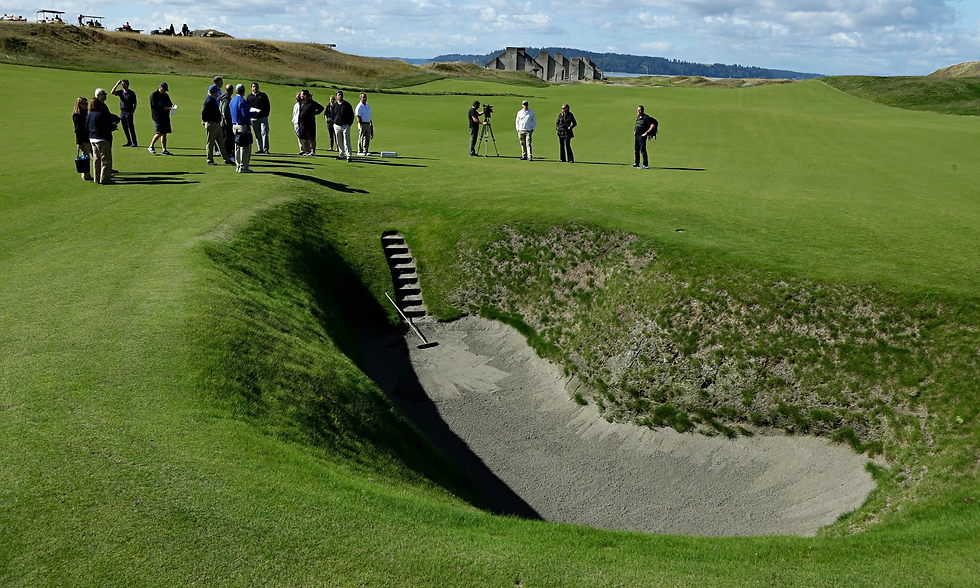
After a few attempts, I found myself in it.
And after a few more attempts, I escaped.
A small victory.
But in golf, small victories are everything.
We finished the round with tired legs and smiles.
I looked over at my brother, who was grinning ear to ear.
Something about that day had clicked.
A few years later, he would become obsessed with golf as so many of us do.
All it takes is one great round.
One perfect afternoon.
One reminder that the game is supposed to be fun.
Chambers Bay was difficult.
Frustrating, Beautiful. Unforgiving.
And completely unforgettable.
A strange mix of history, industry, nature, and golf.
A place unlike anywhere else I have ever played.
And a birthday I will never forget.


Comments